How to Read the AA Big Book — The Complete Guide for Newcomers
Updated: 5 hours ago
If you've picked up the AA Big Book and felt like you were reading a foreign language, you're not alone. The book was written in 1939, and while it's been life-changing for millions, the modern reader hits obstacles on almost every page — archaic vocabulary, 1930s sentence structure, and cultural references that don't parse anymore. This is a guide to actually reading the Big Book in a way that sticks.
Written by people at AAmazingtabs who make physical tabbed Big Books used by AA members and sponsors worldwide, alongside our sister brand AABluebook, the AI-powered recovery companion app.

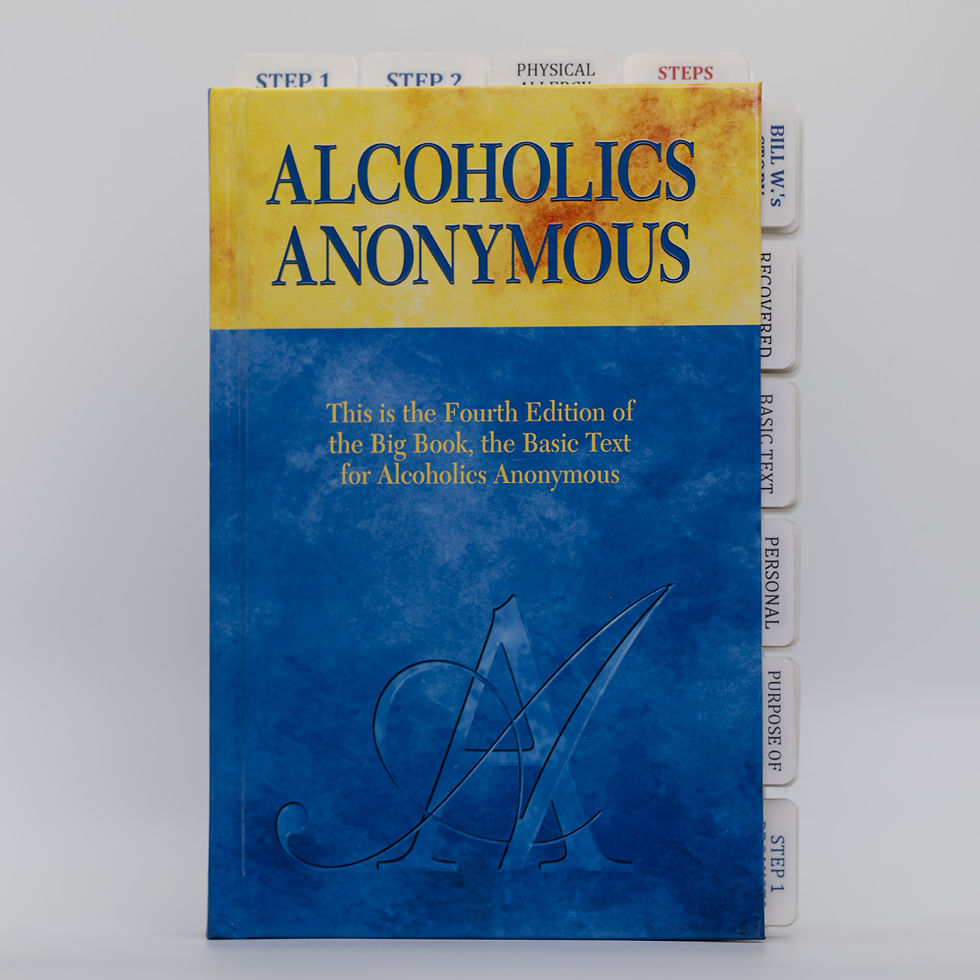
AA Big Book, Highlighted & AAmazingtabbed
Laminated, pre-labeled tabs and color-highlighted passages, ready to use. Ships in 2–4 business days.
Why the Big Book is hard to read
Three things trip people up. First, the vocabulary — words like "cunning," "baffling," "grave," "malady," and "constitutionally" mean specific things that don't match modern casual usage. Second, the sentence structure — Bill W. wrote in long, Latinate 1930s prose. Third, the navigation — the book is dense, and finding specific passages during a meeting or step-work session is genuinely hard without help.
The good news: all three of those problems have solutions in 2026. For decoding the language, we recently published a full guide to every archaic Big Book word explained in modern English on our sister site. For navigation, tabbed Big Books make finding chapters, stories, and prayers effortless. For contextual understanding, digital tools now let you tap words for instant definitions.
Step 1: Get the right physical Big Book
There is no one "correct" Big Book — they're all the same text — but the format matters more than most newcomers realize. If you're planning to actually study the book (not just glance at it), invest in a tabbed edition. Standard Big Books are 570+ pages; finding "How It Works" (Chapter 5) or the Serenity Prayer during a meeting is much faster with tabs.
AAmazingtabs makes tabbed AA Big Books in every format — Standard hardcover, Large Print soft cover, and all 4th Edition variations. We offer them pre-tabbed AND pre-highlighted (ready to use out of the box), or pre-tabbed only (so you can highlight your own). The AAmazingtabs Big Book Kit — Standard Hard Cover (4th Edition) is our most-ordered kit and includes the highlighting guide most sponsors recommend.
Step 2: Read alongside a modern dictionary
This is where the 1930s vocabulary problem gets solved. The AABluebook app includes a built-in 1930s Big Book dictionary — 110+ archaic terms explained as Bill W. would have understood them in 1939. Tap any word in the app's Big Book reader; the definition appears with context. It's the single feature we get the most "why didn't this exist before" feedback about.
The full AABluebook app also includes the entire Big Book with interactive highlighting, notes, and an AI Recovery Coach trained specifically on AA literature — see the complete guide to AI-powered AA recovery apps for how it compares to other apps in the space. Free 1-month trial: https://apps.apple.com/redeem?ctx=offercodes&id=6754885451&code=FREEMONTHFL
Step 3: Read in the right order
Newcomers often start reading the Big Book from page 1, which is not what most sponsors recommend. The Forewords and "Doctor's Opinion" are historical context; they're useful eventually but not the emotional entry point. The recommended sequence for most first-timers:
Read "Bill's Story" (page 1 of the personal narratives) first — it's the emotional hook and gives you Bill W.'s honest account of his own alcoholism
Then "There Is a Solution" (Chapter 2) — the answer to "is there hope?"
Then "More About Alcoholism" (Chapter 3) — the diagnosis you may or may not accept
Then "We Agnostics" (Chapter 4) — the reconciliation for anyone with religious hangups
Then "How It Works" (Chapter 5) — the steps themselves. This is the read most meetings share aloud
Then work through Steps 4 through 12 in sequence with your sponsor
For a much deeper reading-order guide with sponsor notes, see the full How to Read the AA Big Book — Complete Guide for Newcomers & Long-Timers on aabluebook.com.

AAmazingtabs Tabs Kit
144 laminated, pre-labeled tabs to put in your own Big Book. Ships in 2–4 business days.
Step 4: Highlight the right things
Most people highlight everything, which is the same as highlighting nothing. Sponsors recommend a specific color-highlighted system: one color for definitions of alcoholism, one color for the actual step directions, one color for spiritual principles, one color for promises. The pre-highlighted AAmazingtabs Big Book kits use this exact system so you don't have to build it yourself.
Step 5: Read with a sponsor, not alone
The Big Book was never meant to be read in isolation. Every serious reading of it happens in relationship — sponsor and sponsee, home group, step study. If you don't have a sponsor yet, that's the priority: how to find one is a whole topic and there's no shortcut for it. AI recovery coaches (in the AABluebook app or anywhere else) can supplement the between-times, but they don't replace a sponsor.
Step 6: When you hit the 4th Step, get real tools
Step 4 stops more people than any other step. It's where the pen meets the paper, and it can be genuinely overwhelming. If you get to Step 4, don't try to invent the format yourself. Use the AAmazingtabs 4th Step Packet (the physical worksheets sponsors nationwide hand out) alongside the AABluebook step-by-step 4th Step guide (which walks you through the columns with examples).
The physical + digital combination is the most complete setup
Between the AAmazingtabs tabbed Big Book (for physical navigation and highlighting), the AABluebook app (for the 1930s dictionary, AI Recovery Coach, and integrated meeting finder), and your sponsor (for the actual step work), you have everything the modern reader needs to make the Big Book stick.
Shop tabbed AA Big Books at aamazingtabs.com, or try the AABluebook app free for a month: https://apps.apple.com/redeem?ctx=offercodes&id=6754885451&code=FREEMONTHFL (iOS) or code FREEMONTHFL for Android at https://play.google.com/store/apps/details?id=com.aabluebook.android.
Built by people in AA recovery, 30+ years combined. The tools we wished we'd had.
Once you're comfortable reading the Big Book, Step 4 is your next major milestone. Our Complete AA 4th Step Guide with Worksheets shows you exactly how to work it using Big Book language — sponsor-approved.

DIY Big Book Kits
A Big Book with tabs and highlighters, so you can set it up yourself. DIY kits ship in 2–4 business days.
Take the Big Book with you: get the AAmazingtabs app. App Store · Google Play


Comments