Fall Back Into the Big Book: An Autumn Study Plan for Sponsors and Sponsees
There is something about autumn that makes us want to get organized. The light changes, the evenings get longer, and the coffee pot at the Tuesday night meeting starts working overtime. For a lot of us in the rooms, fall is the season we open the Big Book again. Not because we finished it, but because it never really finishes with us.
If you sponsor people, or you are a sponsee looking for a steady rhythm, an AA Big Book study in the fall is one of the best gifts you can give your recovery. This guide lays out a simple 12-week plan, one chapter or section a week, that starts in mid-October and lands you on the last page right around the New Year. Along the way we will look at where these chapters came from, a few words that read a little differently than they did in the 1930s, and how to keep a study group going when the holidays get busy.
Why Fall Is a Natural Time for an AA Big Book Study
Seasons give us a built-in calendar. Summer scatters everybody: vacations, kids out of school, long weekends at the lake. By October, people are back in their routines, home groups fill back up, and the newcomers who came in over the summer are ready for more than a slogan on the wall.
Then there are the holidays. Thanksgiving, Christmas and New Year's Eve can be some of the hardest days of the year for people in early sobriety. A weekly study that runs straight through the season gives sponsees a standing appointment, a place to be on a Thursday night in December when the office party is happening without them.
Honestly, it is good for sponsors too. Many of us have been sober long enough to quote whole pages from memory, which is exactly when we stop actually reading them. A slow, fresh pass through the text almost always shows us something we missed the last ten times.
A Little History Before You Open the Book
It helps to know what you are holding. Alcoholics Anonymous traces its beginning to Akron, Ohio, in 1935, when a New York stockbroker named Bill Wilson met an Akron surgeon, Dr. Bob Smith. Bill had gotten sober a few months earlier and was in Akron on a business deal that fell apart. Desperate not to drink, he went looking for another alcoholic to talk to. Dr. Bob had his last drink on June 10, 1935, the date AA counts as its founding.
Both men had ties to the Oxford Group, a Christian fellowship that emphasized self-examination, admitting wrongs, making restitution and helping others. Those ideas shaped what became the Twelve Steps, though the early AA members eventually went their own way.
By the late 1930s, more than one hundred sober men and women had put their experience into a book. Alcoholics Anonymous was published in April 1939, and the fellowship took its name from the title. It opens with "The Doctor's Opinion," written by Dr. William D. Silkworth, the New York physician who treated Bill at Towns Hospital and described alcoholism as an illness rather than a simple failure of willpower.
Later, Bill expanded on each Step in essay form in the 12 & 12 (Twelve Steps and Twelve Traditions). Many sponsors use the two side by side: the Big Book for the directions, the 12 & 12 for the reflection.
The 12-Week Autumn AA Big Book Study Plan
Page numbers below follow the Fourth Edition. If your group reads a different edition, the chapter names will still line you up.
Weeks 1–2: The Doctor's Opinion and Bill's Story (pages xxv–16)
Start where the book starts. Read Dr. Silkworth's letters out loud and ask the group: what did a doctor in the 1930s understand about us that some people still do not? Then read Bill's Story together. Sponsees often find their own story hiding inside his.
Weeks 3–4: There Is a Solution and More About Alcoholism (pages 17–43)
These chapters describe the problem in plain terms. Have each person mark the sentences that sound like their own drinking. When those passages are marked, they are easy to find again on a hard night.
Week 5: We Agnostics (pages 44–57)
This is the chapter for the person who is struggling with the word God. Let it breathe. Do not rush anyone past their questions. Some of the best conversations in a study group happen this week.
Weeks 6–7: How It Works (pages 58–71)
Read the opening pages slowly. The Twelve Steps themselves are printed here. Two short lines are worth pausing on:
"Rarely have we seen a person fail who has thoroughly followed our path." (p. 58)
"Half measures availed us nothing." (p. 59)
Week 7 can cover the inventory instructions. If your sponsees are ready to start writing, our 4th Step Inventory Packet gives them worksheets that follow the Big Book's own columns.
Weeks 8–9: Into Action (pages 72–88)
Steps Five through Eleven live here, along with the passage many people call the Promises. Spend extra time on the amends section. It is where a lot of fear lives, and it is where a sponsor's experience matters most.
Week 10: Working With Others (pages 89–103)
"Practical experience shows that nothing will so much insure immunity from drinking as intensive work with other alcoholics." (p. 89)
This is a natural week to talk about holiday service: covering a meeting, making coffee, picking up the phone for a newcomer on Christmas Eve.
Week 11: To Wives, The Family Afterward and To Employers (pages 104–150)
These chapters show their age in places, and that is okay. Read them for the principles rather than the social customs of 1939. Family members in the group, especially those who also go to Al-Anon, often get a lot out of this week.
Week 12: A Vision for You (pages 151–164)
End the year where the book ends. The final page holds some of the warmest lines in the text, including this simple instruction:
"Clear away the wreckage of your past." (p. 164)
Finishing this chapter in the last week of December gives everyone a natural bridge into the new year.

1930s Words That Read Differently Today
The Big Book was written in the language of its time, and a few words carry meanings that are easy to miss in 2026.
Inventory. In the 1930s this was a shopkeeper's word. The book makes the comparison itself on page 64: a business that never counts its stock usually goes broke. It is stock-taking, not self-punishment.
Half measures. Not half the effort. It means a partial commitment: doing the parts of the program we like and skipping the rest.
Wreckage. What is left after a crash. The book means the damage we left behind, and it says plainly that it can be cleared away.
Spiritual experience. Appendix II explains that most members have the slow, educational kind rather than a sudden flash. That is good news for sponsees waiting for lightning.
If you enjoy this part of the study, the AABluebook app includes a 1930s dictionary so you can look up a word right in the middle of a reading. On iOS, the code FREEMONTHFL gives you a free month, and 3FREE gives you three.
Tips for Sponsors Running a Fall Study Group
Pick one night and protect it. Consistency matters more than length. Forty-five minutes every week beats two hours once a month.
Read aloud. Hearing the words in different voices helps them land, and it gives quieter members an easy way to take part.
Use the same edition. Page numbers matter when someone says, look at the second paragraph on page 86.
Mark the book. Highlighting and tabs turn a study into something people can come back to long after the group ends.
Plan the holidays now. Decide in October whether you will meet Thanksgiving week and Christmas week, and tell the group early.
Leave room for the newcomer. Someone will walk in during week six. Welcome them, hand them a book and catch them up over coffee.
For more on the nuts and bolts of running the group itself, see our guide on how to lead an AA Big Book study group.
Tools That Make a Fall Study Easier
You do not need anything but a Big Book and a willing group. That said, a few tools save real time when a room full of people is turning pages together.
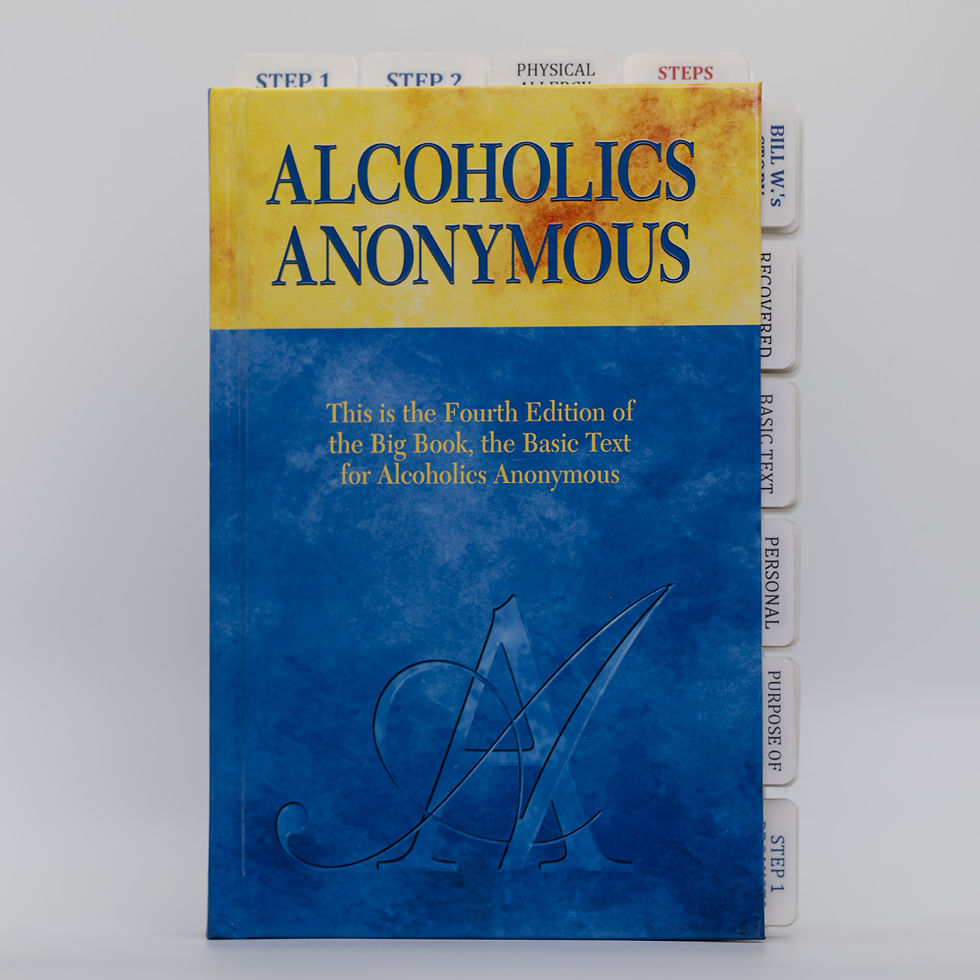
Our AA Big Book, highlighted and AAmazingtabbed comes with 144 laminated, pre-labeled tabs and color-highlighted key passages, so a study group can find the Doctor's Opinion, the Steps or the Promises in seconds. If eyes get tired at night (ours too), the large print edition has the same tabs and highlighting in bigger type. Groups that study the 12 & 12 alongside the Big Book often start with one of our AA book bundles.
Frequently Asked Questions
How long does an AA Big Book study take?
It depends on the group. This plan covers the first 164 pages in 12 weeks. Some groups go slower and spend a whole season on How It Works and Into Action. There is no wrong pace as long as people keep showing up.
Do sponsees need to read ahead?
It helps, but it is not required. Reading aloud together means nobody gets left behind, and newer members often absorb more by hearing the text.
Can we include the personal stories?
Absolutely. Many groups add one story a week after the first 164 pages, or save the stories for a spring study.
Which edition should our group use?
Most groups use the Fourth Edition, which is what the page numbers in this plan reference. The main thing is that everyone in the room uses the same one.
Is a highlighted Big Book a good fit for a new sponsee?
Many sponsors find it helps newcomers find key passages faster. The text is exactly the same; the highlighting and tabs simply make it easier to navigate.
Fall gives us a fresh start without waiting for January. Open the book, invite a few people and see what the season brings. We will be here with the coffee on.
AAmazingtabs is not affiliated with Alcoholics Anonymous World Services.


Comments