How to Lead an AA Big Book Study Group — The Sponsor's Complete Guide
Updated: 3 days ago
A Big Book study group is one of the most powerful recovery tools in AA — and one of the most easily derailed by poor structure. Years of sponsoring and leading Big Book studies have taught us exactly what works. Here's how to set one up and keep it running.
Format: What the Study Should Cover
A Big Book study group works best when it follows the book itself, in order, from the beginning. Most groups cover 3-5 pages per session. Start with Doctor's Opinion (page xxiii) — most groups skip this, and they shouldn't. Then There Is a Solution (page 17), Bill's Story (page 1), How It Works (page 58), Into Action (page 72), and Working With Others (page 89). Cover them in order. The Big Book is a single argument, chapter by chapter.
What Every Participant Needs
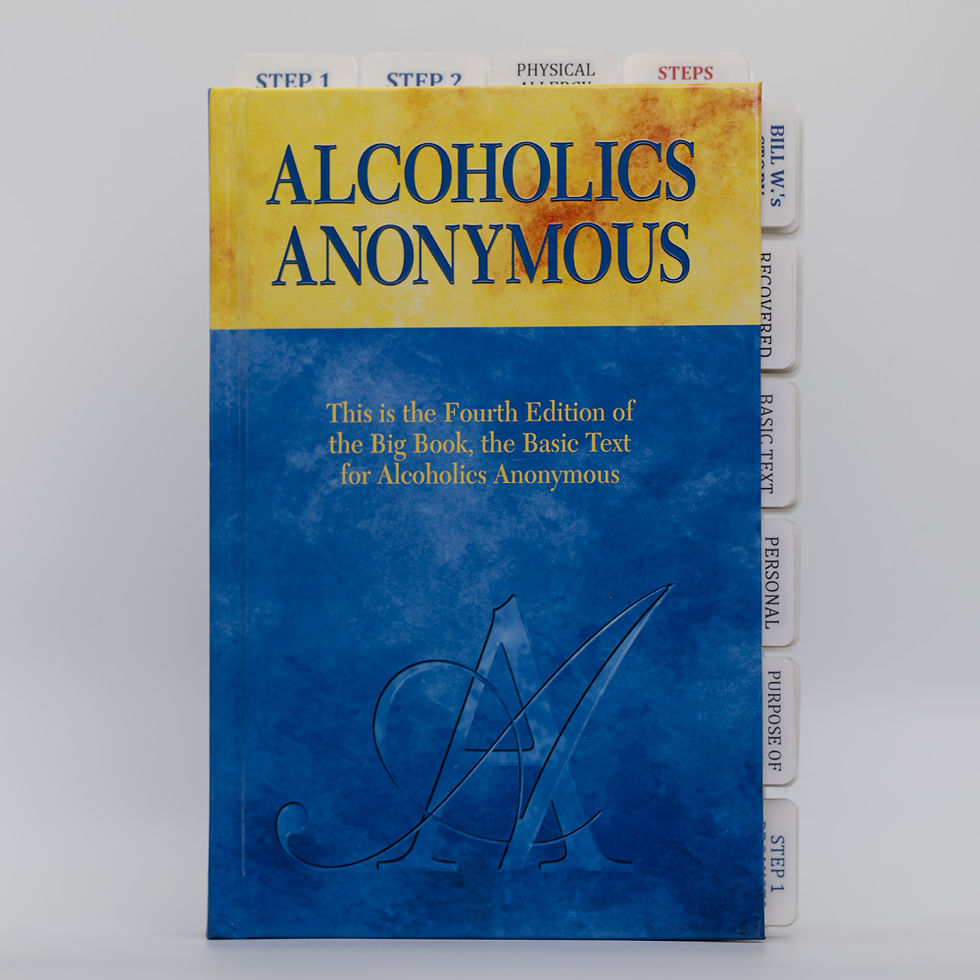
Everyone in a Big Book study group should have the same edition and the same organizational system. When everyone's book has the same 144 laminated, pre-labeled tabs marking the same passages, the group moves faster. The leader says 'turn to page 63' and everyone's there in two seconds.
The pre-tabbed and highlighted AA Big Book is ideal for study groups. For participants who want to do their own highlighting, the AAmazingtabs Tabs Kit gives them the tab system without pre-done highlighting — they can mark up their own copy during the study itself.
For groups buying multiple copies, we offer wholesale pricing for AA groups and intergroups starting at 5 units. Contact us at info@aamazingtabs.com for pricing.
Meeting Structure
5 minutes — Open
Open with the Serenity Prayer. Introduce any new members. State the reading goal for the session.
30-35 minutes — Read aloud
Rotate reading around the group — one person reads one paragraph, then passes. The leader stops the group to discuss anything that needs unpacking. Big Book language can be dense, and a good leader explains as they go.
15 minutes — Open discussion
What did people hear? What landed? What questions came up? Keep it tied to the text.
5 minutes — Close
Assign reading or step action for the week before the next session. Close with the group's standard prayer.
What the Leader Should Have
The group leader should have a pre-tabbed and highlighted AA Big Book to flip quickly to any passage under discussion, the Complete 4th Step Inventory Packet to hand to anyone ready to start their inventory, and Stick-It's AA Prayer Sticky Notes to distribute to new members at the prayer passages.

Common Mistakes
Skipping chapters
Some groups skip Doctor's Opinion or To Wives because they seem less relevant. Don't. The Big Book is a single argument. Skipping disrupts the logical structure.
Moving too fast
Three pages per meeting sounds slow. It's not. When you stop to explain, discuss, and connect the text to lived experience, three pages takes an hour. Groups that rush don't absorb the material.
No clear leader
A Big Book study without a designated leader becomes a discussion group where everyone talks about their feelings. That has its place, but it's not a Big Book study. Someone needs to keep the reading on track.
Not connecting text to action
The Big Book is instructions. After each session, participants should know exactly what action to take before the next one. If everyone leaves with only intellectual understanding and no specific next step, the study isn't working.
For Sponsors Running Individual Step Work
A Big Book study group is different from one-on-one sponsorship, but the same tools apply. Read What Is a Tabbed and Highlighted AA Big Book and our AA Big Book Tabbing & Highlighting Workshop for individual step work. For anyone approaching the Fourth Step, the Complete 4th Step Inventory Packet is the right tool.
Browse AA recovery tools and study materials or contact us at info@aamazingtabs.com — we can help you set up your group with the right books at the right price.
If your group gets stuck on older words, AABlueBook's 1930s Big Book dictionary explains many of them.
Take the Big Book with you: get the AAmazingtabs app. App Store · Google Play
AAmazingtabs is not affiliated with Alcoholics Anonymous World Services, Inc.



Comments